
Signed unit-level identity
Each unit receives a unique identifier, signed by the manufacturer or importer that places it on the market.
Each 120 ml oral-solution bottle carries a unique QR from its packaging. The identity is issued, printed and activated after production; every subsequent lookup compares the unit with its record.
A lot identifies a group; the Traza QR identifies each unit. Bottle and carton support comparison of product, concentration, dosage form, manufacturer or importer, health registration, lot and expiry. The example data does not refer to an authorised medicine.
Field inspection faces a volume it cannot cover without signals to guide it. Teams go where they can, not necessarily where they are needed, and what they observe is rarely linked to the unit’s registry record.
The public, for its part, has no simple way to verify what it buys. Tools that require installing something or creating an account are not used at the moment of purchase. The proposal starts from that reality: web-based verification, with no installation or account, at the point of sale.
The pilot is proposed with a narrow scope: a set of products, a small group of chain actors and a defined period, with field inspection included from the start.
Each unit receives a unique identifier, signed by the manufacturer or importer that places it on the market.
The QR is printed on the carton, label or seal during packaging. Every unit retains its identifier; one code is not reused for the entire lot.
Issuance → printing → activation after production → lookup and control. Closing the lot record activates only the units actually produced.
Anyone verifies from the browser and receives a result explained by signals, with the regulator’s context.
Inspectors verify on site, check against the registry and record what they observe within the pilot itself.
Whoever detects a difference between the unit and the registry can report it with minimal, optional data.
Visible identity. Connected traceability.
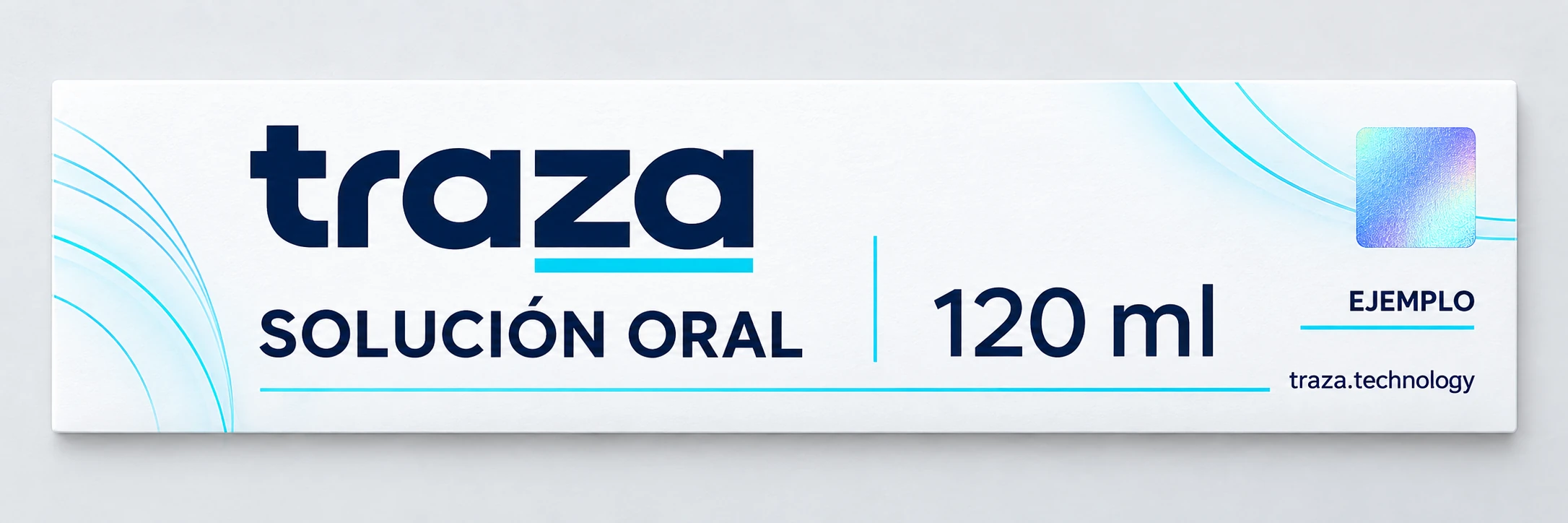
The proposed stamp brings together each unit’s identity and medicine details. The QR opens its lookup; the barcode represents the example print sequence.
Opens this unit’s public URL. A copy of the graphic retains the same identifier.
The readable ID matches the QR and can be entered manually to look up the unit.
Defined for each implementation. This example declares no jurisdiction or actual territorial operation.
The visible domain shows where to look up the identity, including outside this page.
An example number for the printed piece. It is separate from the unit identifier.
A readable Code 128 symbol encoding the example print sequence. It represents neither GS1 identification nor fiscal validation.
Volume comes from the registered presentation: 120 ml for this unit.
The name lets people compare the package with the record of the unit being checked.
Dosage form and strength matching the example medicine.
Manufacturer or importer and declared health reference. RS-EJEMPLO does not represent official approval.
When the identity was issued. It is separate from production, activation or expiry.
A separate field matching the batch of the unit being looked up.
The proposal describes six roles. Each one sees the registry with the level of detail that corresponds to it.
Defines the framework, governs the registry, follows anomalies and reports, and directs field inspection. In the proposal, this role corresponds to the recipient of the pilot.
Request identities for their units and complete product, concentration, dosage form, health registration, lot and expiry. They are responsible for the declared data.
Print identifiers on packaging, check readability and close the record when production ends. This confirmation activates the codes used.
Make the code available to the public and compare packaging with its record. The pilot does not record sales, transport or distribution.
Verify on site, check the physical unit against the registry and document what they observe.
Verifies at the point of sale, reads a clear result and reports if something does not match.
The proposal describes the architecture the pilot would be designed toward. It is presented as a target, not as a built system.
Each identifier is signed with elliptic-curve cryptography (ECDSA P-256) using keys managed by the issuer. It is proposed as the standard for the use case.
A web service evaluates signature, registry status, data match and anomalies, and returns an explained result.
A record of issuance, printing, activation, lookups, signals and closure, with responsible party and date. No logistics movements need to be recorded.
Tools for inspectors to verify on site and record observations linked to each unit.
A public channel to report differences between the unit and the registry, with minimal, optional data.
Physical anti-copy measures and validation of tax payments would be evaluated in a later phase. Tax validation depends on integration with and authorisation from the competent authority; it is not available in this example. A digital signature alone does not prevent copying a label.
The proposal does not defer field inspection to a later phase: it includes it from the start. Signals from the registry guide the teams, and what they observe on site flows back into the registry. What arrives later is the dedicated inspector application; at first the work is done with the same web pages and the institutional views.
The proposal allows a public and/or private company to present verification alongside Traza. The band and example use the Traza palette; each participant’s brand requires authorisation.
Example co-brand for a pilot proposal. It does not imply an official relationship, approval or implementation.
The tenant lockup shown is a co-brand example included in a pilot proposal. Its use is subject to approval by the corresponding institution and does not imply an official relationship, endorsement or approval.
To avoid confusion, we put in writing what this page does not say.
Public verification with the sample tenant, the lifecycle of a medicine bottle and the institutional view show how the pilot would look.